
Everyone’s seen the numbers thrown around — a jalapeño is “a few thousand,” a Carolina Reaper is “over two million” — but what do they actually mean? The Scoville scale is how we measure chilli heat, and once you understand it, those numbers go from meaningless to genuinely useful (and, honestly, a bit addictive). This is the Scoville scale explained in plain English, with a heat ladder that puts everything from a salad capsicum to police pepper spray in perspective.
Stick around for the end, where we answer the question every chilli lover eventually asks: is pepper spray really hotter than the world’s hottest chilli? (Spoiler: yes, and we’ve got the numbers to prove it.)
The short version: the Scoville scale measures how much capsaicin — the compound that makes chillies hot — is in a chilli, in Scoville Heat Units (SHU). A capsicum scores 0; a jalapeño a few thousand; a Carolina Reaper over 1.6 million on average. The more capsaicin, the higher the number, the bigger the burn.
What is the Scoville scale?
The Scoville scale is a measurement of chilli heat, running from 0 (no heat at all) up into the millions. It’s named after Wilbur Scoville, an American pharmacist who came up with the test back in 1912.
His original method was wonderfully low-tech. A chilli extract was diluted in sugar water, over and over, and a panel of tasters sipped each dilution until they could no longer feel any heat. The number of dilutions it took to kill the burn became the chilli’s rating in Scoville Heat Units (SHU). A chilli that needed diluting 10,000 times before the heat vanished scored 10,000 SHU.
It worked, but it had an obvious flaw: it relied on human tongues, which disagree. Results could swing by as much as 50% between panels. So these days, labs use a machine instead — high-performance liquid chromatography (HPLC) — which measures the actual capsaicin content directly and converts it to SHU. Far more precise, far fewer burnt tasters.
What is a Scoville Heat Unit actually measuring?
One thing: capsaicin. That’s the active compound in chillies that triggers the heat receptors in your mouth — the same ones that respond to actual heat, which is why your brain thinks your tongue is on fire. More capsaicin means a higher SHU.
For reference, pure capsaicin clocks in at 16,000,000 SHU — the theoretical ceiling. Every chilli on earth is just some fraction of that.

The Scoville scale, from mild to meltdown
Here’s the heat ladder. These are published ranges — real chillies vary with growing conditions, so treat them as the ballpark, not the law.
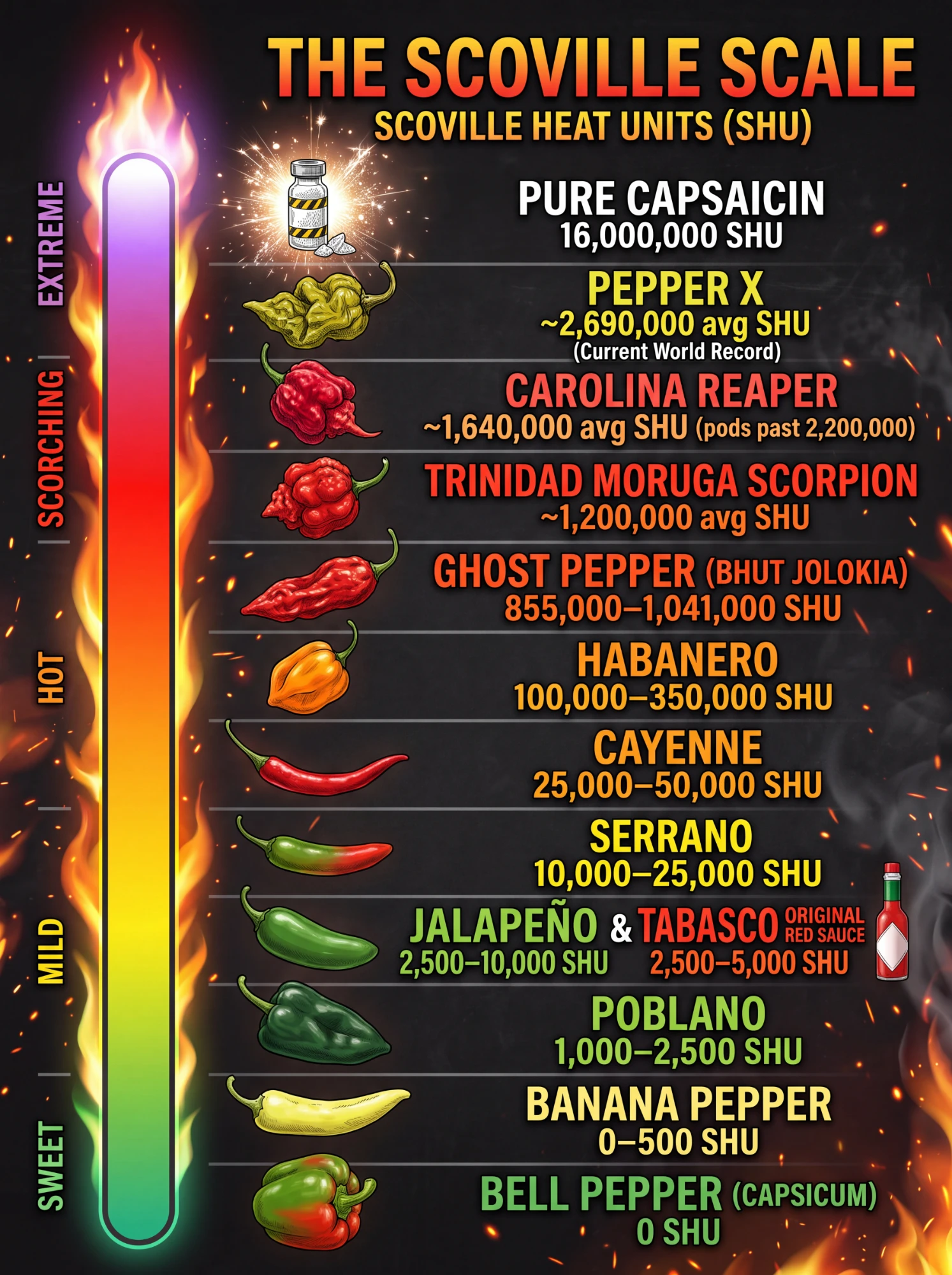
| Chilli / item | Scoville Heat Units (SHU) |
|---|---|
| Pure capsaicin | 16,000,000 |
| Pepper X (current world record) | ~2,690,000 avg |
| Carolina Reaper | ~1,640,000 avg (pods past 2,200,000) |
| Trinidad Moruga Scorpion | ~1,200,000 avg |
| Ghost Pepper (Bhut Jolokia) | 855,000–1,041,000 |
| Habanero | 100,000–350,000 |
| Cayenne | 25,000–50,000 |
| Serrano | 10,000–25,000 |
| Jalapeño | 2,500–10,000 |
| Tabasco Original Red Sauce | 2,500–5,000 |
| Poblano | 1,000–2,500 |
| Banana chilli | 0–500 |
| Capsicum | 0 |
Want to know where our own varieties sit? Every seed in the shop lists its heat rating and Scoville range, from the mild range through to the extreme range. For a closer look, see our guide to the best chillies for beginners and our superhot comparison.
Putting the numbers in perspective
Big numbers stop meaning much once they pass a few hundred thousand, so let’s make them relatable.
- The capsicum in your salad is a flat zero. No capsaicin, no heat. The honest bottom of the scale.
- A jalapeño (2,500–10,000) is about the same heat as a good shake of Tabasco sauce. This is the “everyone’s tried this” rung of the ladder.
- A habanero is roughly 40 to 50 times hotter than a jalapeño. That’s the jump that separates “nice kick” from “why is my face sweating.”
- A Ghost Pepper was the first chilli ever verified over a million SHU — that’s around 100 to 400 times a jalapeño.
- A Carolina Reaper’s hottest pods (past 2.2 million) are up to roughly 880 times a jalapeño. At this point you’re not seasoning food, you’re conducting an experiment on yourself.
And then there’s the kicker.
Is pepper spray hotter than a Carolina Reaper?
Yes — and it’s not even close.
Police and military-grade pepper spray is made from the same stuff that’s in chillies (oleoresin capsicum — concentrated capsaicin), and it’s rated right on the Scoville scale. Law-enforcement sprays generally run from 500,000 up to around 5,000,000 SHU, and some of the strongest — like Fox Labs’ police formulas — are rated at 5,300,000 SHU.
Line that up against the chillies: a Carolina Reaper’s hottest pods top out around 2.2 million SHU, and even the current record-holder Pepper X averages about 2.69 million. So the spray that drops a grown adult is, on the raw Scoville rating, roughly twice as hot as the world’s hottest chilli.
One honest caveat, because we don’t do myths here: that spray figure is the rating of the raw chilli resin, and it’s an aerosol fired into your eyes and lungs — not something anyone eats. So it’s not quite apples to apples with biting into a pod. But on the Scoville number itself, pepper spray genuinely out-burns every chilli on the planet. The “pepper spray is hotter than a Reaper” line you’ve heard is actually true.
The myth-buster: wasabi and black pepper aren’t on the scale at all
Here’s one that surprises people. Wasabi can blow the top of your head off, and freshly cracked black pepper has a real bite — but neither has a true Scoville rating.
The Scoville scale only measures capsaicin. Black pepper’s heat comes from a completely different compound, piperine. Wasabi, horseradish and hot mustard get their nose-searing kick from allyl isothiocyanate — different chemical again. That’s also why wasabi burns your nose and sinuses rather than your tongue, and why the burn vanishes in seconds: it’s a different mechanism entirely.
So if someone tells you wasabi is “hotter than a chilli on the Scoville scale,” they’re mixing up their burns. On the actual capsaicin scale, wasabi scores a big fat zero.
Why the Scoville scale is handy (and where it falls short)
For a grower or a cook, the scale is a brilliant quick guide: it tells you roughly what you’re in for before you take a bite, and it lets you build heat sensibly — jalapeño for the family, cayenne for a bit more, habanero when you’re feeling brave.
But it has limits worth knowing:
- Heat isn’t the whole story. Two chillies at the same SHU can taste wildly different — one fruity, one smoky — and the way the heat arrives (a fast sting vs a slow bloom) isn’t captured by a single number.
- Real pods vary. Growing conditions, ripeness and even which pod on the plant all shift the heat. Published figures are averages, not guarantees.
- Big numbers get silly. Past a million SHU, the differences stop mattering to your mouth — it all just hurts.
Find your rung on the ladder
The best way to understand the Scoville scale is to grow your way up it. Start mild and work your way north as your tolerance (and your bravado) grows. Begin with an easy, low-Scoville jalapeño or serrano from our mild range, and when you’re ready to leave the safe end of the scale behind, the extreme range is waiting. New to growing? Our germination guide will get your seeds up and away.
Just maybe keep the pepper spray comparison in mind before you bite into that Reaper.
Frequently Asked Questions
Who invented the Scoville scale?
The Scoville scale was created by Wilbur Scoville, an American pharmacist, in 1912. His original “Scoville Organoleptic Test” diluted a chilli extract in sugar water until a panel of tasters could no longer detect any heat. The number of dilutions needed became the chilli’s rating in Scoville Heat Units.
How is the Scoville scale measured today?
Modern labs use high-performance liquid chromatography (HPLC), a machine that measures the actual capsaicin content of a chilli and converts it to Scoville Heat Units. It’s far more precise and objective than Scoville’s original taste-panel method, which could vary by up to 50% between different groups of tasters.
What is the hottest thing on the Scoville scale?
Pure capsaicin — the compound that makes chillies hot — tops the scale at 16,000,000 SHU. Among actual chillies, Pepper X holds the current world record at around 2.69 million SHU on average. Police-grade pepper spray, made from concentrated capsaicin, can be rated even higher, up to about 5.3 million SHU.
Is pepper spray hotter than a Carolina Reaper?
Yes, on the Scoville rating. Law-enforcement pepper sprays run from around 500,000 up to 5,000,000 SHU, with the strongest rated near 5.3 million — roughly twice the heat of a Carolina Reaper’s hottest pods. The difference is that pepper spray is an aerosol concentrate fired at the eyes, not a chilli you eat.
What does SHU mean?
SHU stands for Scoville Heat Units, the measurement of a chilli’s heat on the Scoville scale. It reflects how much capsaicin a chilli contains — the more capsaicin, the higher the SHU and the hotter the chilli. A capsicum is 0 SHU; a Carolina Reaper averages over 1.6 million.
Where do wasabi and black pepper sit on the Scoville scale?
Neither has a true Scoville rating, because the scale only measures capsaicin. Black pepper’s heat comes from piperine, and wasabi, horseradish and mustard get their kick from allyl isothiocyanate — different compounds entirely. That’s why wasabi burns your nose rather than your tongue, and why the sensation fades so quickly.
How hot is a jalapeño on the Scoville scale?
A jalapeño sits around 2,500 to 10,000 Scoville Heat Units — roughly the same heat as a good dash of Tabasco sauce. That makes it mild on the overall scale: a habanero is about 40 times hotter, and a Carolina Reaper can be hundreds of times hotter again.